
NewsNEWCENTER
Featured products

Contact Us
MCCB: The Safety Sentinel of Your Distribution System
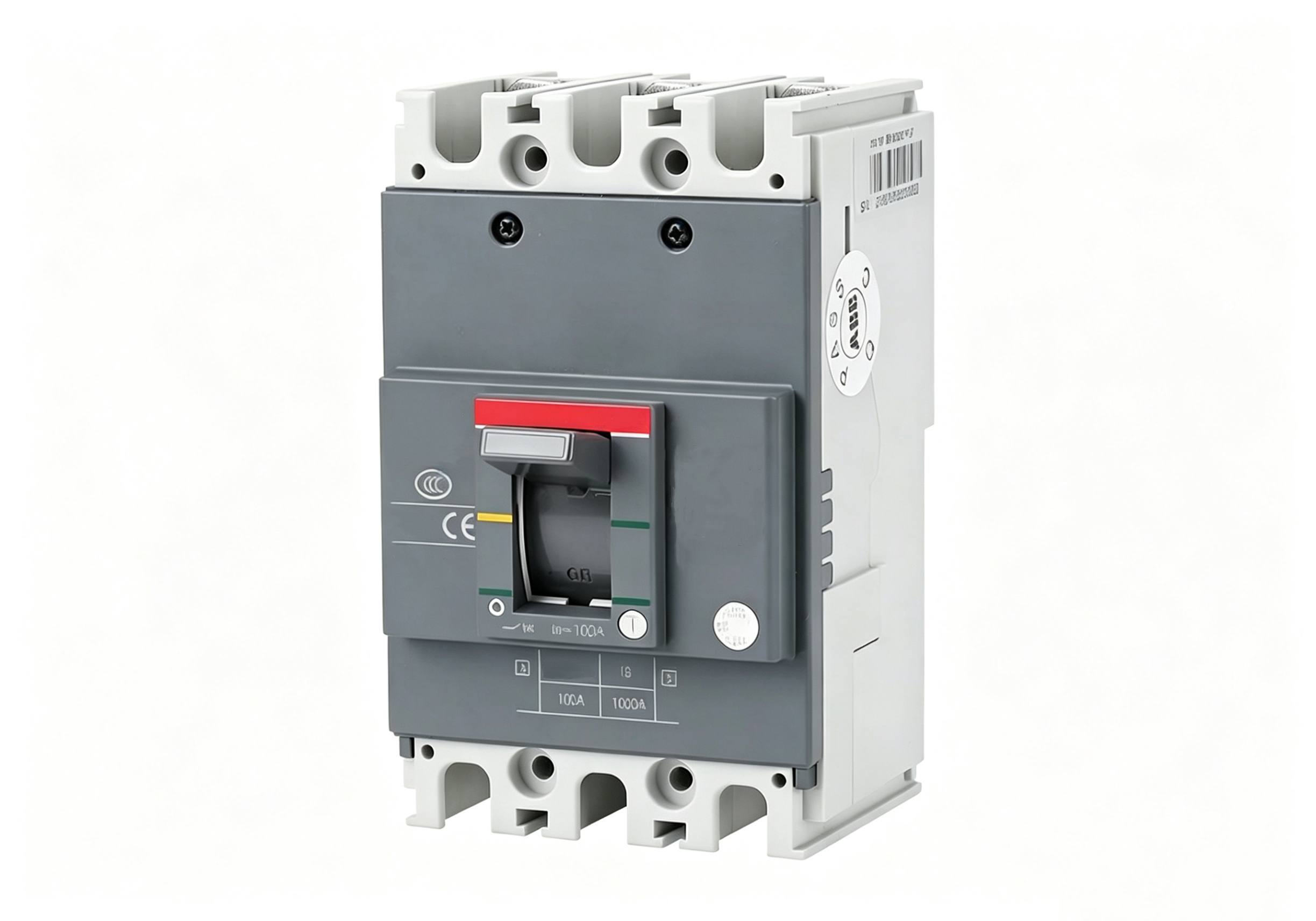
2026-08-03If you ever open an industrial distribution cabinet or a floor electrical room, chances are you will see rows of black or grey square devices—these are molded case circuit breakers (MCCBs). Though they look unassuming, they serve as the “last line of defense” for cables and equipment: when current rises abnormally, they can interrupt the fault within tens of milliseconds, preventing cable fires, motor burnouts, or even more severe accidents. What distinguishes an MCCB from a common miniature circuit breaker (MCB)? MCBs are typically used for lighting, sockets, and other small-current end circuits with rated currents not exceeding 63A, whereas MCCBs cover a range from 16A to 800A, making them suitable for main feeders, high-power motors, and incoming lines of distribution boxes. Their housing is made of molded plastic, and the internal contacts, arc chambers, and trip units are all enclosed within a sturdy casing—hence the name “molded case.” The core working principle is not complicated: inside an MCCB there are two protection mechanisms—thermal protection (bimetallic strip) where overload current heats the strip and bends it to push the trip mechanism, with the bending speed proportional to the overcurrent level (inverse-time characteristic); and magnetic protection (electromagnetic coil) where a short circuit causes an instantaneous surge (several to tens of times the rated current) that generates enough magnetic force to directly push the armature and achieve instantaneous tripping without delay. Higher-end models are equipped with electronic trip units that use microprocessors to precisely calculate current waveforms, offering more adjustable parameters and more accurate protection curves, especially suitable for harmonic‑sensitive systems or selective coordination applications. When selecting an MCCB, many users focus only on the rated current, but several other parameters are equally critical: the ultimate breaking capacity (Icu) is the maximum short‑circuit current the breaker can safely interrupt—if the actual short‑circuit current exceeds Icu, the breaker may explode or fail to open, so you must calculate the short‑circuit current based on system impedance and leave a margin; the trip curve (B/C/D type) matters because B type is for resistive loads (lighting), C type for general distribution, and D type specially for motor loads with high inrush currents (start‑up currents can reach 7‑10 times the rated value, and using C type may cause nuisance tripping); and the number of poles—three‑phase systems usually use 3P or 4P (with neutral protection), but whether the neutral needs protection depends on the grounding system (for example, in TN‑C systems the PEN conductor must never be interrupted). In installation and maintenance, easily overlooked details include terminal screw torque—too loose causes heating and fire risk, too tight may crush the conductor or damage the terminal, so always use a torque wrench per the manufacturer’s specified values; ambient temperature—the rated current is given at 30°C or 40°C, and if the cabinet temperature is higher, derating is necessary to avoid nuisance tripping or accelerated aging; and periodic testing—the mechanical mechanism may stick if left inactive for long, so it is advisable to manually operate the “ON/OFF” button once a year and check the arc chamber for carbon deposits or metal splashes. For common fault diagnosis, if you cannot close the breaker, first check for short circuits or ground faults; if the fault is cleared but it still won’t close, the trip unit may be damaged. If it trips without an obvious overload, loose terminals causing heat transfer to the bimetal are often the culprit—tighten the terminals. And after a thermal trip, you cannot immediately reset because the bimetal needs cooling time; wait 1‑2 minutes before attempting to re‑close. Although the MCCB may seem simple, it is an indispensable safety sentinel in any distribution system. With the right model choice, proper installation, and regular maintenance, it will silently safeguard your equipment for years or even decades. Next time you see those black boxes inside a distribution cabinet, take a closer look at their ratings—they embody a whole set of electrical safety logic.